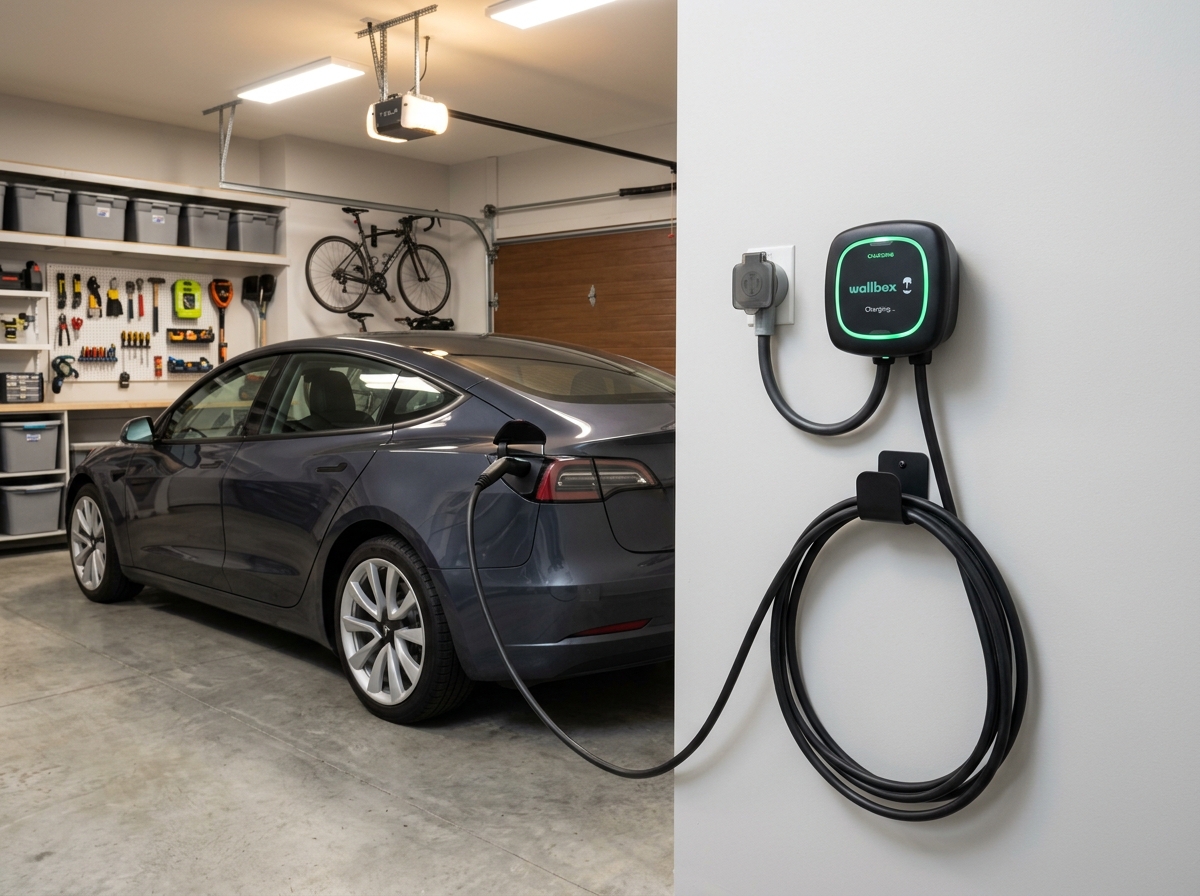
Home EV Charging Solutions for Delray Beach Homeowners
Standard 120-volt Level 1 trickle chargers supply only 3 to 5 miles of range per hour of charging. Installing a dedicated 240-volt Level 2 electric vehicle charger increases charging speeds to 25–45 miles of range per hour, enabling full battery replenishment overnight.
Whether you drive a Tesla Model S/3/X/Y, Cybertruck, Rivian, Ford F-150 Lightning, Chevy EV, Hyundai Ioniq, or BMW i4, our licensed electricians handle every aspect of installation—from panel capacity load calculations to running heavy-gauge copper conduit and mounting NEMA 14-50 receptacles or hardwired wall connectors.
Supported EV Charger Manufacturers
- Tesla Universal Wall Connector: Hardwired 48-amp charging with integrated NACS and J1772 adapters.
- ChargePoint Home Flex: Flexible 16A to 50A indoor/outdoor smart charger with Wi-Fi power scheduling.
- Emporia & JuiceBox 40/48: High-performance Level 2 wall boxes with app energy monitoring.
- NEMA 14-50 & 6-50 Receptacles: Heavy-duty commercial-grade 240V outlets for plug-in mobile EV chargers.
EV Installation Engineering & Code Compliance
- NEC Article 625 Load Calculation: Verifying existing panel capacity. If main panel amperage is maxed out, a 200-amp panel upgrade may be required.
- Dedicated Circuit Wiring: Running THHN copper conductors (#6 AWG copper for 50A or #4 AWG for 60A) inside schedule 80 PVC or EMT conduit from the panel board.
- Double-Pole GFCI Breaker Installation: Installing a dedicated 40A, 50A, or 60A double-pole circuit breaker complying with NEC 625.54 GFCI mandates.
- Hardwired Wall Box Commissioning: Mounting the wall connector, setting internal DIP switches for maximum continuous load (80% rule: 48A continuous on 60A circuit), and running thermal tests.
EV Charger Pricing & Cost Breakdown
To estimate installation costs based on distance from your panel and electrical panel headroom, read our comprehensive EV Charger Installation Cost Guide.